
The NHS Pay Deal - Year 2
Recap of the three-year deal in England
In 2018 the NHS Staff Council agreed to reform the NHS pay structure over a three-year period covering April 2018 to March 2021. This reform delivered the following:
- Won the argument that the top of the band was the full rate for the job
- Secured an additional £4.2 billion to fully fund the deal for directly employed NHS staff
- Living wage as the lowest rate of pay
- Re-profiling band 1 jobs in to band 2
- Increases of 6.5% over the three years for staff at the top of Bands 2-8c
- Reducing the length of time to get to the top of the band by deleting pay points
- Removal of overlaps between pay bands by deleting pay points
- Improvements to starting salaries
- No detriment clause – everyone better off compared to what they would have had with 1% + increments
1 April 2019 marks the start of year two of the agreement. Further pay points are deleted as part of the move to increase starting salaries and reduce the length of time it takes to reach the top of most pay bands.
Summary of main changes in Year 2 – from 1 April 2019
Staff at the top of the pay band Staff at the top of their pay band will see their annual basic pay increase through the annual pay uplift effective on 1 April. For bands 2-8c this increase is 1.7%.
Staff employed on the top of their band on 31 March 2019 will receive a one-off 1.1 per cent non-consolidated lump sum cash payment. This will be paid in April salaries.
For staff at the top of bands 8d and 9 their basic pay increase and their one-off non-consolidated lump sum will be capped at the level of the increase for the top of band 8c.
Staff not yet at the top of their pay band Some staff will have their pay point deleted this year as part of the pay restructure. These staff will receive both an annual pay uplift and transitional pay progression on 1 April, effectively receiving their pay progression early.
Other staff will receive an annual pay uplift on 1 April and then receive their transitional pay progression on their pay step date (formerly known as their incremental date).
The NHS Staff Council pay journey tool Link no longer available will show individual staff how their pay will change year on year including annual pay uplifts and individual progression, if they are not at the top of their pay band. To use the tool staff will need to know their spine point on 31 March 2018 if they were employed on or before this point. Staff employed on or after 1 April 2018 will not need to know any spine point information.
Additional information
From 1 April 2019 the minimum basic pay rate in the pay structure will increase to £17,652. This means the lowest paid staff will see their hourly rate rise to £9.03 which is higher than the Living Wage Foundation rate for 2019.
The high cost area supplements from 1 April 2019 are set out in Annex 9 of the NHS terms and conditions of service handbook. Where staff are eligible to receive this supplement, payment is made in addition to their annual base salary.
Changes to earnings can result in changes to tax, National Insurance, pension contributions, student loan repayments and eligibility for tax credits and benefits.
One off non-consolidated cash lump sum
Staff at the top of band 2-9 Staff employed on the top of bands 2-8c on 31 March 2019 will receive a one-off non-consolidated lump sum cash payment worth 1.1% of the value of annual basic pay. Part-time staff will receive payment on a pro-rata basis.
This will be paid in April 2019 and will appear on pay slips as “Non Consol Pay NP”. NP stands for non-pensionable.
Staff at the top of bands 8d and 9 on 31 March 2019 have the value of the one-off non-consolidated lump sum cash payment capped at the value of the payment for staff at the top of band 8c.
Annex 2 of the NHS terms and conditions handbook confirms the full-time equivalent value of the 1.1 per cent non-consolidated lump sum payments that a full-time staff member in bands 2-9 should receive.
Staff in post but not at work, including staff on maternity, paternity, or sickness absence, will receive the lump sum.
ESR will automatically make payment of the 1.1% lump sum where a member of staff is at the top of their band on 31 March 2019 and remains there on 1 April 2019.
Staff are still eligible to receive the payment if they are on top of band on 31 March 2019 but not in post on 1 April, but where this is the case organisations will need to make the payment manually.
For staff who are eligible to receive the non-consolidated cash lump sum but change employers before they are paid the lump sum, this should be paid by the organisation in which they were employed as at 31 March 2019. Local arrangements will need to be put in place to ensure accurate and timely payment is made. Employers have been told that the process for doing this should be discussed in partnership between joint staff side and employers, so UNISON branches should approach the employer to ensure that happens.
Staff in band 1 A non-consolidated cash lump sum worth 1.1% of the value of band 1 annual basic pay from 1 April 2019 will be paid to all band 1 staff in April, regardless of whether they remain in band 1, have already transitioned to band 2, or will transition to band 2 on 1 April via the national process.
New entrants to band 2 that have not transferred as part of the national process will not be eligible for this payment. Staff who move in to a band 2 role via a promotion, i.e. staff who apply for a band 2 role and have the provisions as set out in Section 6, England of the NHS TCS Handbook applied are also not eligible for this payment.
Staff working less than full time will receive payment on a pro-rata basis. In all cases the payment will be worth 1.1% of annual basic pay of band 1 from April 2019.
ESR will automatically make the payment to band 1 staff in post at 31 March who remain in post on 1 April. ESR will not be able to make these payments automatically for band 1 staff transferring to band 2 as part of the national process and therefore, local arrangements will need to be made to ensure this is paid. UNISON branches should take the lead and approach employers to talk about that process.
Pay Progression
Existing staff Existing staff for the purposes of pay progression are those staff who were in post before 1 April 2019. Staff who change roles but still work in the same band will also be considered existing staff as they have not been promoted.
For these staff, their current organisational pay progression procedures will continue to apply until 31 March 2021. From 1 April 2021 the new arrangements will apply. The effect of this is that during transition staff not yet at the top of their pay band will receive a combination of pay uplifts and pay progression as per current arrangements
New staff and promotions on or after 1 April With effect from 1 April 2019, all staff commencing NHS employment and those staff who are promoted on or after this date will be subject to the new pay progression arrangements. Promotion is considered to be moving to a higher banded role.
Further detail on pay progression The NHS trade unions have published joint guidance for staff side representatives Link no longer available.
Reading the pay scales
From April 2018 until March 2021 the pay structure is in transition. Pay can change at two points during the year, once on 1 April through the pay uplift (move across the table) and once on your incremental date as you move to the next pay point in your band (move down the table).
Pay points are deleted to make starting salaries higher and to reduce the length of time it takes to reach the top of most bands. This means there are moments when some pay values appear the same, this is where staff receive both an annual pay uplift and transitional pay progression on 1 April effectively receiving their pay progression early. No-one will miss out on their increment during this transition. In all cases a duplicate pay value in the same year shows that staff receive their increment early.
The reference to “Years of experience” works for most staff. If staff started higher than the lowest point in the band the pay scale should be read as if they have automatically gained the experience for points they skipped.
Lots of these issues are a result of using pre-existing payroll systems to deliver the transition to a reformed pay structure. Once we have reached the final pay structure by 1 April 2021 the full pay scales will be much simpler.
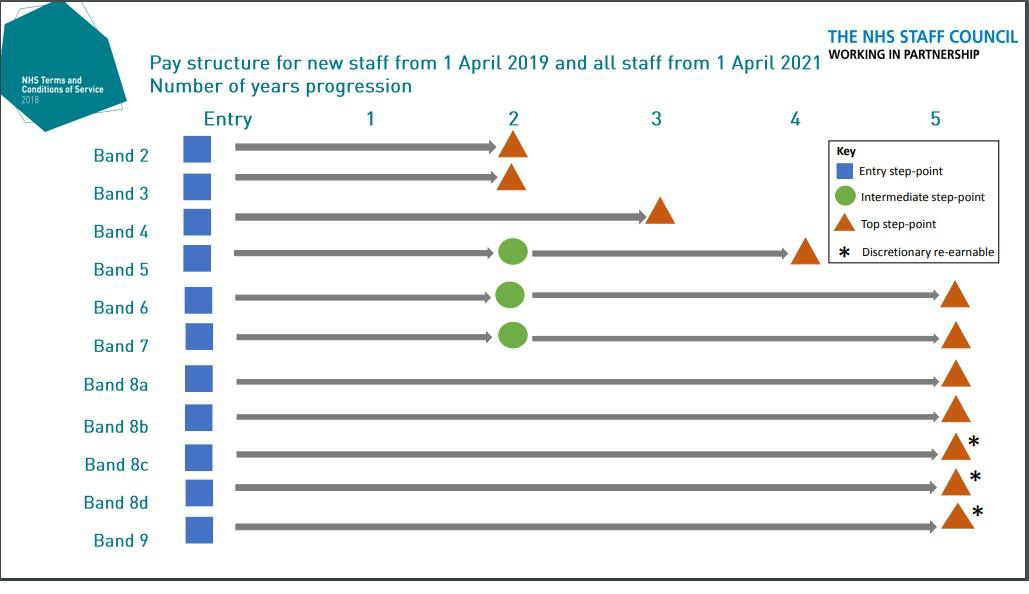
The full pay scales are available in Annex 2 of the NHS terms and conditions handbook.